
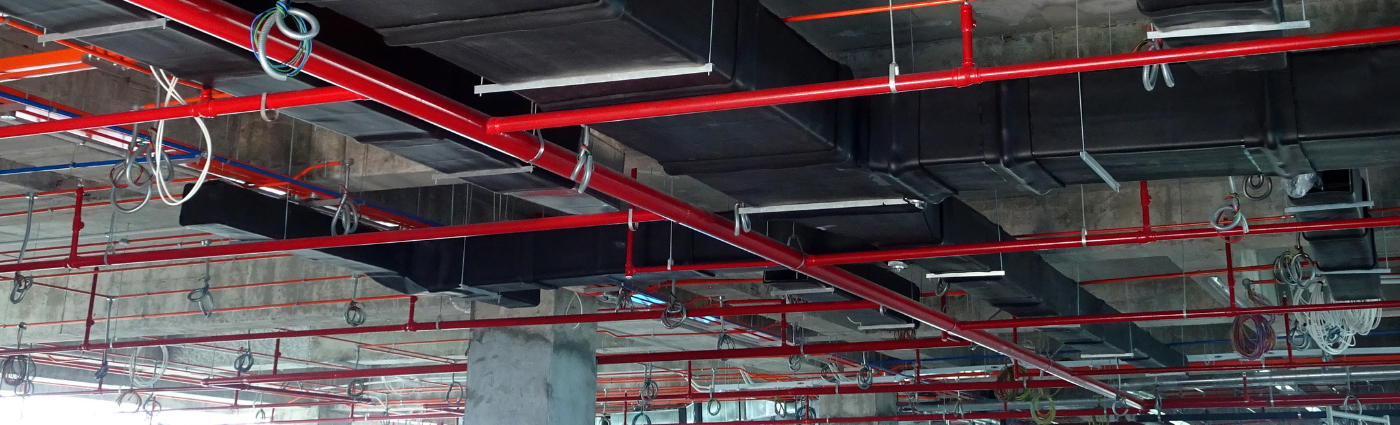
The fire safety standards ASTM E84, UL 723, and NFPA 255 are commonly referenced in building codes, specifications, and product data sheets. Some elastomeric foam insulation manufacturers reference one, two, or all three standards in their technical data, which can cause confusion for engineers, building owners, contractors, and specifiers trying to understand what each one means. This post is meant to help clarify the similarities and differences amongst these commonly utilized standards.
All three standards evaluate the surface burning characteristics of building materials using the same core testing methodology. However, they originate from different standards organizations and have evolved over time.
What Are ASTM E84, UL 723 and NFPA 255?
Although they are closely related, each standard was developed and maintained by a different organization:
- ASTM E84 → ASTM International
- UL 723 → UL Solutions
- NFPA 255 → National Fire Protection Association
ASTM E84, UL 723, and NFPA 255 are all fire test standards used to evaluate the surface burning characteristics of building materials using the Steiner Tunnel Test.
What Is the Steiner Tunnel Test?
The Steiner Tunnel Test is used to evaluate how quickly flame spreads across the surface of a material and how much smoke the material generates during combustion.
During testing:
- A material sample is installed in a horizontal tunnel apparatus
- The sample is exposed to a controlled flame source
- Flame spread and smoke development are measured over a specified time period on a scale from 0 (cement board) and 100 (red oak)
The results of the test measure:
- Flame spread across the surface of a material, measured using flame spread index (FSI)
- Smoke developed during fire exposure, measured using smoke-developed index (SDI)
These values are commonly referenced in building and mechanical codes to determine where materials may be used within a building. The flame spread index (FSI) for pipe and duct insulation used in an air plenum must be 25 or less and smoke developed index (SDI) 50 or less, commonly referred to as “25/50” rated.
What Is ASTM E84?
ASTM International, formerly known as the American Society of Testing and Materials, is a non-profit organization of industry volunteers who develop voluntary standards for materials, products, systems, and services. ASTM adopted UL 723 in 1961 and titled their standard ASTM E84 25/50 “Standard Test Method for Surface Burning Characteristics of Building Materials”.
ASTM E84 is widely referenced throughout:
- Building codes
- Mechanical codes
- Product specifications
- Construction submittals
The standard is commonly used to evaluate building materials including:
- Mechanical insulation
- Duct insulation
- Wall and ceiling materials
- Interior finish materials
ASTM E84 remains one of the most widely recognized surface burning test standards used in North America today.
What Is UL 723?
UL 723 is the first industry-recognized fire test standard, developed by Underwriters Laboratories, Inc. (UL) in 1950 and called UL 723 “Test for Surface Burning Characteristics of Building Materials” using the Steiner Tunnel Test.
Updated throughout the years, the purpose of UL 723 is to evaluate the relative burning characteristics of a material. Today, many specifications, product submittals, and code references still use UL 723 terminology, particularly in HVAC and mechanical insulation applications.
UL 723 and ASTM E84 use the same test methodology, so they are generally considered equivalent in practice.
What Is NFPA 255?
The National Fire Protection Association (NFPA) adopted UL 723 in 1955 using the Steiner Tunnel methodology and titling their standard NFPA 255 “Standard Method of Test of Surface Burning Characteristics of Building Materials.”
NFPA 255 was historically considered equivalent to ASTM E84 and UL 723. The NFPA Technical Committee withdrew NFPA 255 in 2011 since it was technically equivalent and now references ASTM E84 25/50. As a result, older specifications and technical documents may still reference NFPA 255 even though the standard is no longer actively maintained.
Are ASTM E84 and UL 723 the Same?
ASTM E84 and UL 723 are generally considered equivalent fire test standards because they use the same Steiner Tunnel testing methodology to evaluate surface burning characteristics.
Both standards measure:
- Flame spread
- Smoke development
In practice, many manufacturers, code officials, and design professionals treat ASTM E84 and UL 723 results as interchangeable for compliance purposes.
However, specifications may still reference one standard over another based on:
- Legacy specification language
- Historical code adoption
- Organizational preference
- Product certification requirements
Why Do Specifications Reference Multiple Standards?
Project specifications and product documentation may reference ASTM E84, UL 723, and NFPA 255 together.
This occurs because:
- Older specifications may still reference NFPA 255
- Some manufacturers historically tested to UL 723
- ASTM E84 became more broadly adopted over time
- Different codes and specification templates evolved independently
As a result, multiple standards may appear together to ensure compliance certainty for building codes, even though they evaluate the same core fire performance characteristics.
Which Fire Test Standards Are Referenced Today?
Modern building and mechanical codes primarily reference ASTM E84 and UL 723 when evaluating the surface burning characteristics of building materials. NFPA 255 may still appear in older specifications and legacy project documentation, but it is no longer the primary active standard.
The following model codes and standards reference ASTM E84 25/50 (UL 723) for insulation materials:
- International Building Code (IBC)
- International Mechanical Code (IMC)
- International Fire Code (IFC)
- International Residential Code (IRC)
- Uniform Mechanical Code (UMC)
- NFPA 90A—Standard for the Installation of Air-Conditioning and Ventilating Systems
To summarize, ASTM E84 25/50 and UL 723 both utilize the Steiner Tunnel test, process, and update their standards concurrently, so they are essentially the same test method.
Since model building codes reference ASTM E84 25/50 and UL 723, identifying, specifying, and installing closed cell elastomeric foam pipe and duct insulation from reputable U.S. manufacturers that publish a 25/50 rating per ASTM E84 25/50 and/or UL 723 will ensure safe mechanical design and code compliance.
How These Standards Apply to Mechanical Insulation
Fire performance standards such as ASTM E84 and UL 723 are commonly used to evaluate mechanical insulation systems. These standards help determine whether insulation materials meet building and mechanical code requirements for flame spread and smoke development.
For a detailed explanation of ASTM E84 25/50 requirements for insulation systems and plenum applications, see our guide to ASTM E84 25/50 insulation requirements.
It is also important to note that due to increasing insulation thicknesses needed to meet energy codes and demanding condensation control applications, it’s important to ensure that the insulation thickness selected passes 25/50 if required for your project. Typically, closed cell elastomeric foam passes in the U.S. up to 2” [50 mm] thick. However, non-halogen formulas are limited in their ability to pass ASTM E84 25/50 or UL 723 without flame retardants, so check with the manufacturer under consideration.
To learn more about which Aeroflex products are ASTM E84 25/50 compliant, please click here.
Frequently Asked Questions About ASTM E84, UL 723 and NFPA 255
Is UL 723 the same as ASTM E84?
UL 723 and ASTM E84 are generally considered equivalent because they use the same Steiner Tunnel testing methodology to evaluate surface burning characteristics.
What is UL 723?
UL 723 is a fire test standard published by UL Solutions for measuring flame spread and smoke development of building materials.
What happened to NFPA 255?
NFPA 255 was withdrawn and is no longer actively maintained, though older specifications may still reference it.
What is the Steiner Tunnel Test?
The Steiner Tunnel Test evaluates how quickly flames spread across a material’s surface and how much smoke is generated during combustion.
Why do specifications reference multiple fire test standards?
Many specifications evolved over time and may reference ASTM E84, UL 723, or NFPA 255 based on historical usage, code adoption, or manufacturer documentation.
Sources
- ASTM E84 Standard Test Method for Surface Burning Characteristics of Building Materials
- UL 723 Standard for Test for Surface Burning Characteristics of Building Materials
- NFPA 255 Standard Method of Test of Surface Burning Characteristics of Building Materials
- 2024 International Mechanical Code (IMC)
- International Building Code (IBC)