
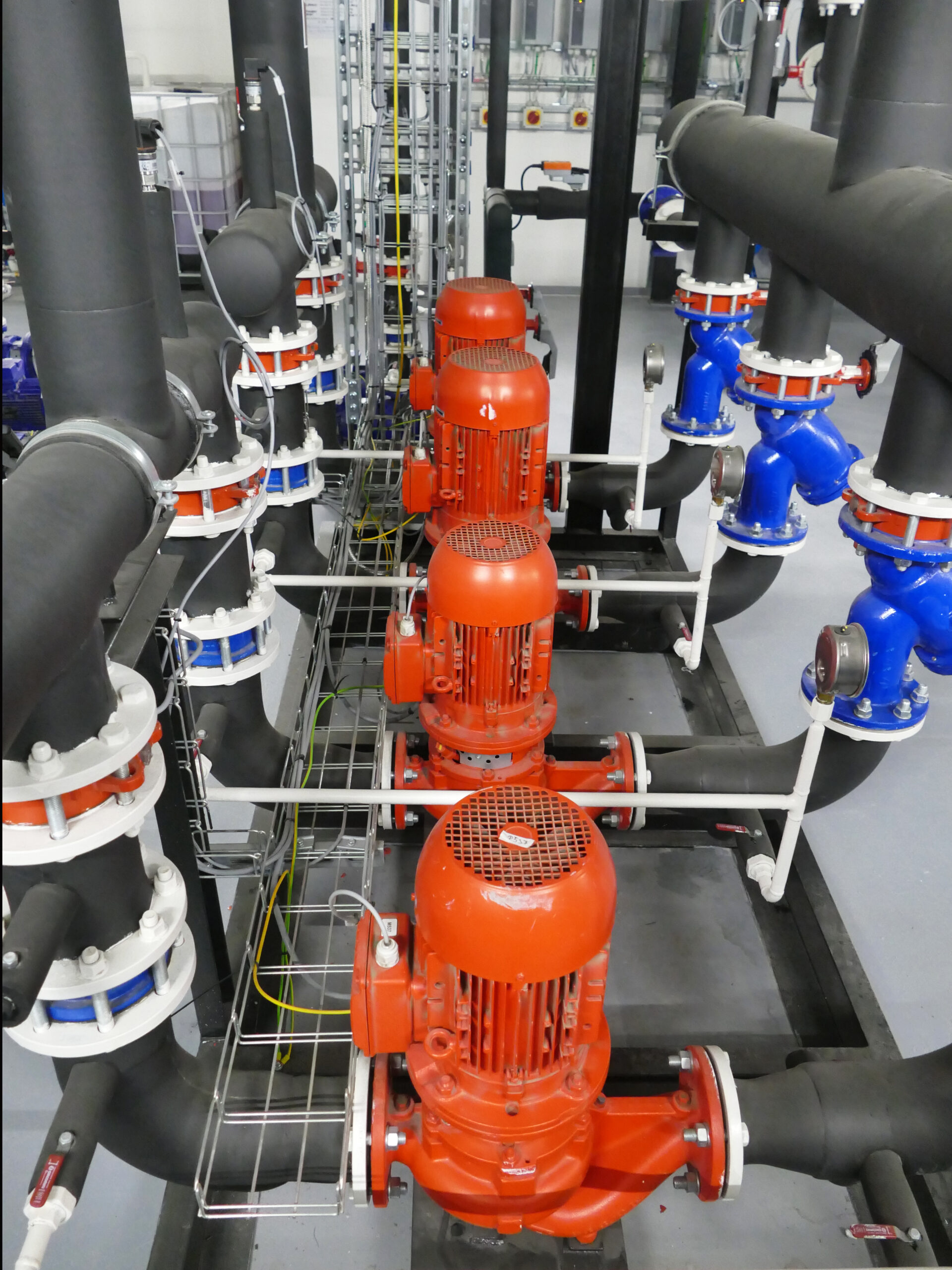
Refrigerant pipe insulation is critical in commercial refrigeration systems because it helps control heat gain, prevent surface condensation, and maintain long-term thermal performance. Unlike above-ambient mechanical systems, refrigerant piping operates below ambient air temperature, making condensation control and moisture management primary design considerations.
2022 ASHRAE Handbook—Refrigeration! identifies several closed-cell insulation materials suitable for refrigeration piping due to their low water vapor permeability and low water absorption. These include flexible elastomeric foam, cellular glass, polyisocyanurate, phenolic, and polystyrene.
Whether serving supermarket refrigeration, beverage dispensing systems, laboratories, data centers, industrial refrigeration, chillers, or ice rinks, refrigerant pipe insulation material should be selected based on the system’s low operating temperature, environmental conditions, applicable energy codes, and project specifications. Evaluate thermal conductivity, water vapor permeability, water absorption, and continuous service temperature, and determine the appropriate insulation thickness to prevent condensation.
This guide explains how to select refrigerant pipe insulation for commercial refrigeration applications, including the key performance properties to evaluate, how to determine proper insulation thickness, and best practices for designing and installing an insulation system that delivers reliable, long-term condensation control.
Why Refrigerant Pipe Insulation Matters
Commercial refrigeration systems are designed to operate continuously under demanding conditions, running twenty-four hours a day, and experiencing a wide range of operating temperatures, all while maintaining precise temperatures to avoid costly downtime.
One of the greatest challenges facing below-ambient piping systems is condensation.
When the surface temperature of refrigerant piping falls below the surrounding air’s dew point, moisture in the air condenses on the pipe surface. Left unchecked, this condensation can create a chain reaction of problems, including:
- Decreased thermal efficiency
- Corrosion under insulation (CUI)
- Surface icing
- Mold & mildew growth
- Premature insulation deterioration
- Increased maintenance costs
- System failure
Properly selected and specified refrigerant pipe insulation systems can help keep the insulation surface above the dew point while minimizing heat gain into the system. This not only improves system efficiency but also helps extend the service life of both the insulation and the refrigeration piping and equipment.
Because condensation control is the primary objective for most below-ambient insulation systems, insulation material selection and thickness calculation should always be based on the actual operating conditions, rather than pipe size alone. These include:
- Pipe type (in addition to size)
- Ambient temperature
- Relative humidity
- Wind speed (if applicable)
- Jacketing
Interested in learning more about designing specifically for condensation prevention and how to calculate proper insulation thickness? Read more in our article on Condensation Control for Below-Ambient Cold Mechanical Systems.
Key Performance Properties of Refrigerant Pipe Insulation
Not all insulation materials perform equally on below-ambient systems. The ASHRAE Handbook recommends closed-cell types of refrigerant pipe insulation for refrigeration system applications due to their low water vapor transmission (WVT), low water absorption qualities, and not always requiring a supplemental vapor barrier. No single insulation property determines long-term performance. Instead, engineers should evaluate several key performance characteristics together when selecting insulation for commercial refrigeration systems.
Thermal Conductivity (K Value)
Thermal conductivity, commonly referred to as the K value, measures how readily heat passes through an insulation material. Lower thermal conductivity means better resistance to heat transfer, helping refrigerant piping and equipment maintain their desired operating temperature while reducing energy losses.
R value and thermal conductivity are inverse measures of heat transfer; thus, insulation with a lower K value provides higher thermal resistance (R value) for a given thickness.
Beware that commercially available closed-cell elastomeric foam insulation is not created equal. K-values vary by manufacturer and insulation thickness. For example, some manufacturers report consistent k-values through all thicknesses (through 2”) while others report that k-values increase over 1” thick. It’s important to compare k-values published in manufacturer technical data sheets.
Low Water Vapor Permeability (WVP)
For below-ambient applications, water vapor permeability, often expressed as perm rating (perm-inch), may be the single most important insulation performance property.
Even small amounts of water vapor migrating through insulation can condense when they reach colder pipe surfaces, reducing thermal performance and potentially leading to hidden moisture damage.
Closed-cell insulation materials help resist water vapor transmission, making them particularly well suited for refrigeration applications where long-term condensation control is critical.
Beware that commercially available closed-cell elastomeric foam insulation is not created equal. Perm ratings vary by manufacturer and insulation thickness. For example, some manufacturers report consistently low perm ratings through all thicknesses (through 2”) while others report that perm ratings increase over 1” thick. It’s important to compare perm ratings published in manufacturer technical data sheets.
Low Water Absorption
Insulation should also resist absorption of liquid water. Materials that absorb moisture often experience reduced thermal performance and may require premature replacement if they become saturated.
Selecting insulation with low water absorption helps preserve long-term thermal efficiency. The closed-cell structure of insulation materials recommended by ASHRAE makes them resistant to water absorption, and therefore a reliable long-term insulation solution for refrigeration systems.
Continuous Service Temperature
Commercial refrigeration systems may operate from approximately 20°F to 60°F, while industrial refrigeration systems, including ammonia applications, can operate as low as -50°F. During intermittent defrost cycles, insulation may also be exposed to temperatures approaching 250°F. Selecting insulation with an appropriate continuous service temperature helps ensure reliable long-term performance across the full operating range.
Key Performance Properties & Industry Standards
Refrigerant pipe insulation should be selected based on the performance characteristics required for the application, not simply the insulation material itself. The table below summarizes the most important considerations for commercial refrigeration systems. Flexible elastomeric insulation products are commonly tested against the performance standards listed below. Always verify compliance using current manufacturer documentation
| Performance Property | Why It Matters | Common Test Standard | ||||||
| Thermal Conductivity (K value) | Helps reduce heat gain in the refrigeration system and maintain operating efficiency. Lower K values provide greater thermal resistance. | ASTM C518 | ||||||
| Water Vapor Permeability (Perm Rating) | Helps prevent water vapor from reaching cold pipe surfaces, reducing the risk of condensation. | ASTM E96 | ||||||
| Water Absorption | Minimizes moisture uptake to help maintain long-term thermal performance and reduce the potential for insulation degradation. | ASTM C209 | ||||||
| Continuous Service Temperature | Ensures insulation performs reliably across all expected operating temperatures, including heat cycling. | ASTM C411 | ||||||
| Surface Burning Characteristics | Evaluates flame spread and smoke developed characteristics to comply with building codes. | ASTM E84 / UL 723 | ||||||
| Fungal Resistance | Helps verify the insulation material resists fungal growth, which is especially important in humid environments. | ASTM G21 | ||||||
| Weatherability / UV Resistance* | Important for outdoor installations where insulation may be exposed prior to jacketing or protective coatings. | ASTM G7 | ||||||
* Outdoor insulation should generally be protected using a weather-resistant coating or jacketing system to preserve the integrity of insulation materials against the elements such as UV, severe weather, birds, and vermin.
Why Closed-Cell Elastomeric Insulation Is Commonly Specified
Of the closed-cell refrigerant pipe insulation types referenced above, flexible elastomeric refrigerant pipe insulation has been commercially available in the United States for over 70 years and is a proven solution due to a combination of several performance characteristics critical to long-term system performance.
These include:
- Low thermal conductivity to reduce heat gain
- Built-in vapor barrier (smooth continuous skin) for natural low water vapor permeability and water absorption to help prevent moisture intrusion and condensation
- Flexible construction for easier installation around valves, fittings, and complex piping systems
- Broad continuous service temperature range
- Long-term durability in demanding commercial environments
These characteristics help support long-term thermal performance when properly specified and installed.
Selecting the Proper Insulation Thickness
Choosing the correct insulation thickness is just as important as selecting the insulation material itself. National energy codes specify minimum pipe insulation thicknesses. However, calculations should always be run for below-ambient systems, like refrigeration, where condensation prevention is of the utmost importance.
Thickness should be based on the system’s operating conditions to help keep the insulation’s outer surface above the surrounding air’s dew point. This includes pipe size, operating temperature, ambient temperature, humidity, and whether the piping is installed indoors or outdoors.
As refrigeration systems continue to operate at lower temperatures, thicker insulation is increasingly required to maintain effective condensation control. To learn more about insulation thickness calculations, read our article Calculating Insulation Thickness to Control Condensation.
Installation Best Practices for Refrigeration Insulation
To ensure the long-term performance of a flexible elastomeric refrigerant pipe insulation system installation, it’s critical that the following criteria are met:
- All longitudinal seams, butt joints, pipe supports, and termination points are completely sealed with the manufacturer’s adhesive to provide a continuous vapor barrier to prevent vapor drive from penetrating the insulation system
- Tape should only be used as an additional closure system and should not replace proper seam sealing with the manufacturer’s recommended contact adhesive.
- When installed in exterior environments such as commercial rooftops, refrigerant pipe insulation should be protected from solar radiation with the manufacturer’s specially formulated protective coating (meets national energy code requirement) or jacketed if mechanical damage is expected (foot traffic, birds, vermin, or severe weather).
- Stagger seams if installing multilayer systems (see Aeroflex USA’s Installation Guide for more details on best practices)
Pipe supports also deserve special attention as they are a common failure point in insulation systems. Standard hangers can compress insulation, creating potential for moisture and condensation. Purpose-built insulated pipe supports, such as Aerofix® Pipe Supports, provide seamless thermal performance and zero-permeance (zero-perm) moisture resistance. Designed for use with elastomeric insulation systems, Aerofix Pipe Supports also ensure consistent insulation thickness and eliminate compression at support points, helping engineers and contractors maintain system performance from specification through installation.
A comprehensive installation guide for AEROFLEX EPDM Insulation can be found here or by clicking the button below.
Consider the Complete Insulation System
Successful condensation control depends on more than insulation material selection. Insulation thickness, seam sealing, pipe supports, proper adhesives, and outdoor protection all contribute to long-term system performance.
As refrigeration operating temperature requirements continue to decrease, thicker insulation is often required. While this has traditionally meant nesting multiple insulation layers, specifying a single-layer insulation tube with the required wall thickness can simplify installation by reducing labor and minimizing the number of seams that must be sealed.
AEROFLEX EPDM Tube Insulation is stocked in wall thicknesses up to 2 inches, allowing many refrigeration applications to be insulated with a single layer. For exposed interior mechanical systems, AEROFLEX EPDM Pipe Insulation is also available in White/Gray to better blend with finished commercial interiors.
Aeroflex® Refrigerant Pipe Insulation Solutions
AEROFLEX EPDM flexible elastomeric insulation is American-made in Sweetwater, Tennessee, and engineered for demanding commercial refrigeration applications. AEROFLEX Pipe Insulation is stocked in wall thicknesses up to 2 inches, allowing many projects requiring thicker insulation to be completed using a single insulation layer rather than nested insulation. This can help simplify installation while reducing the number of seams that require sealing.
EPDM offers hydrophobic, closed-cell construction, broad operating temperature range, and long-term flexibility to help support reliable condensation control. Combined with complementary products, including AEROFLEX Self-Seal® Pipe Insulation, Standard Tube Insulation, Aerofix Pipe Supports, contact adhesives, and insulation coatings, Aeroflex USA provides a comprehensive suite of products for a complete insulation system for below-ambient piping applications. Explore our complete line of Refrigerant Insulation Solutions here.
Frequently Asked Questions
What are the best materials for refrigeration pipe insulation?
For commercial refrigeration systems operating below ambient temperature, ASHRAE identifies several closed-cell insulation materials suitable for refrigeration piping, including flexible elastomeric foam, cellular glass, polyisocyanurate, phenolic, and polystyrene. These materials are commonly specified because they offer low water vapor transmission and low water absorption, two critical characteristics for controlling condensation, a top priority for below-ambient systems.
How to calculate refrigeration pipe insulation thickness
There is no single insulation thickness that is appropriate for every refrigeration system.
Insulation thickness should be calculated based on the operating conditions of the system. These include refrigerant temperature, pipe size, ambient temperature, relative humidity, wind speed (if applicable), and whether the piping is installed indoors or outdoors. The goal is to maintain an outer insulation surface temperature above the ambient air dew point to prevent condensation.
Minimum insulation thicknesses may also be prescribed by project specifications or energy codes such as ASHRAE 90.1 and the International Energy Conservation Code (IECC), although additional thickness may be required to achieve condensation control under specific operating conditions. You can learn more about how insulation thickness is calculated in our guide to calculating insulation thickness to control condensation.
Why is water vapor permeability important?
Water vapor permeability measures how readily moisture vapor passes through an insulation material. It is typically evaluated using ASTM E96.
Because refrigerant piping operates below ambient temperature, water vapor that migrates into the insulation system can condense on the colder pipe surface. Over time, this hidden moisture can reduce thermal performance, promote mold growth, contribute to corrosion under insulation (CUI), and will eventually lead to system failure.
For this reason, insulation materials with low water vapor permeability are specified for below-ambient mechanical systems. Read more about the importance of a perm rating here.
Why is single-layer insulation preferred over nested insulation when possible?
As refrigeration systems continue to operate at lower temperatures, thicker insulation is often required to maintain condensation control.
While nesting multiple insulation layers can achieve the required thickness, specifying a single insulation tube with the required wall thickness can simplify installation by reducing labor and minimizing the number of longitudinal seams and butt joints that must be sealed. Fewer seams help reduce potential paths for moisture intrusion, reduce the number of potential failure points, and improve installation consistency over the life of the insulation system.
AEROFLEX EPDM Elastomeric Pipe Insulation is stocked in wall thicknesses up to 2 inches. This wall thickness allows many commercial refrigeration applications to achieve the required insulation thickness using only a single insulation layer.
Source: https://insulation.org/io/articles/understanding-thermal-systems-basic-cooling-systems/